| 1 Artikel in der Kategorie Forschung |
|
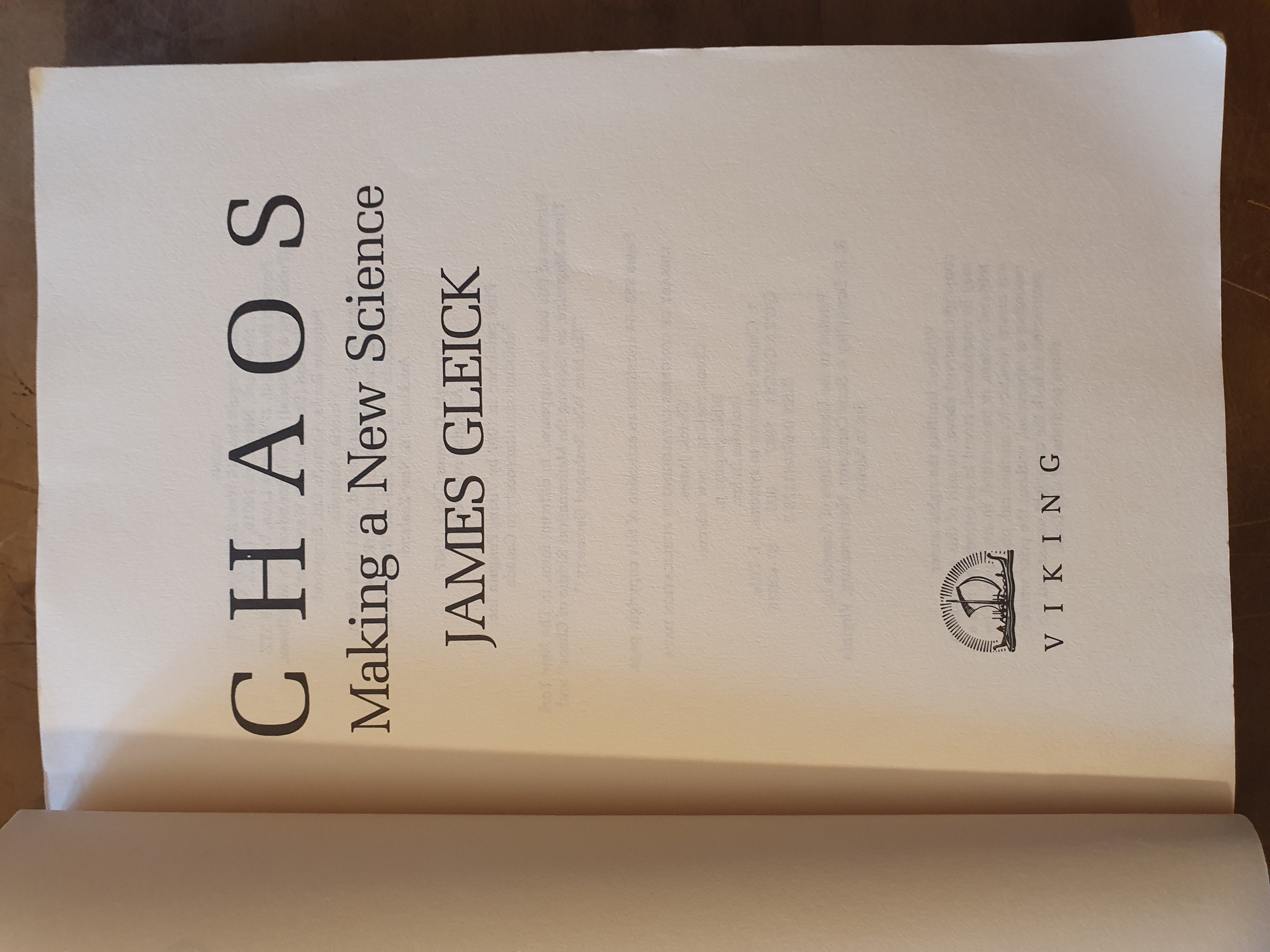
Chaos - Making a new Science / Autor: James Gleick / Verlag: Viking / Englisch / 5.00 CHF / ISBN: 9783512563568
|
|
|
Okay, let's delve into "Chaos: Making a New Science Verlag" by James Gleick, a fascinating and ambitious project. Here's a breakdown of the book, exploring its key themes, Gleick's approach, and what it offers: **1. The Core Concept: A New Science Verlag** * **The Premise:** The book isn't just a
memoir about Gleick's journey to start a publishing house. It's a meticulously researched and deeply philosophical exploration of the *nature of chaos* and how it shapes scientific discovery. Gleick, a renowned mathematician and science writer, envisions "Chaos Verlag" as a deliberately experimental and unconventional publishing house.
* **The Vision:** Gleick wants to create a space where science isn't just about rigorous, predictable results, but also about embracing the unpredictable, the surprising, and the seemingly random. He aims to publish works that challenge conventional thinking, explore the limits of human understanding, and celebrate the beauty of unexpected connections. He's essentially building a "chaos-friendly" publishing house. **2. Gleick's Approach - A Deep Dive into Chaos Theory** * **Beyond the Equations:** Gleick doesn't just present the mathematical framework of chaos theory. He *integrates* it into the very fabric of the publishing house. He's obsessed with the idea that chaos isn't just a mathematical phenomenon; it's a fundamental principle of the universe, influencing everything from weather patterns to the evolution of complex systems. * **The "Chaos-Driven" Process:** The book details Gleick's process of selecting and publishing works that are inherently chaotic. He emphasizes the importance of: * **Unpredictability:** He looks for books that deliberately introduce randomness or uncertainty into the narrative. * **Emergence:** He highlights how complex systems can arise from simple rules, and how these emergent properties can be surprisingly profound. * **Sensitivity to Initial Conditions:** He argues that small changes in the starting point of a system can lead to wildly different outcomes - a core tenet of chaos. * **The Role of the Publisher:** Gleick's Verlag isn't just a distributor. It's a curator, a facilitator, and a champion of unconventional ideas. He's actively seeking out and supporting authors who are pushing the boundaries of scientific thought. **3. Key Themes and Content** * **The History of Chaos Theory:** Gleick provides a comprehensive and engaging history of the development of chaos theory, tracing its roots from mathematicians like Lorenz and Klein to its modern-day applications in physics, biology, and computer science. * **The Nature of Creativity:** The book explores how chaos theory can inform our understanding of creativity and innovation. It suggests that true breakthroughs often arise from embracing uncertainty and allowing for unexpected connections. * **The Limits of Prediction:** Gleick examines the inherent limitations of predicting the future, both in science and in life. He argues that embracing chaos allows us to be more adaptable and resilient. * **The Power of Observation:** The book emphasizes the importance of careful observation and the willingness to question established assumptions. * **The Role of the Reader:** Gleick's Verlag isn't just about publishing scientific papers; it's about fostering a culture of curiosity and intellectual exploration. **4. Why "Chaos" is a Unique Book** * **It's a Personal Narrative:** The book is deeply rooted in Gleick's own journey and his fascination with chaos. It's a reflection on his own intellectual and creative process. * **It's a Manifesto:** "Chaos" isn't just a book about publishing; it's a philosophical statement about the nature of knowledge and the role of the scientist. * **It's a Celebration of the Unexpected:** Gleick's Verlag is a place where the seemingly impossible can be realized, and where the beauty of the unknown is celebrated. **5. Overall Impression** "Chaos: Making a New Science Verlag" is a truly remarkable and thought-provoking book. It's a blend of scientific rigor, philosophical reflection, and a wonderfully imaginative vision. It's not always an easy read - it demands attention and a willingness to grapple with complex ideas - but it's a rewarding one. It's a book that will challenge your assumptions about science, creativity, and the nature of reality. --- **Resources for Further Reading:** * **The Book:** [https://www.amazon.com/Chaos-Making-New-Science-Verlag/dp/1610228363](https://www.amazon.com/Chaos-Making-New-Science-Verlag/dp/1610228363) * **James Gleick's Website:** [https://www.jamesgleick.com/](https://www.jamesgleick.com/) (Provides more context and background on Gleick's work) To help me tailor my response further, could you tell me: * What specifically about the book are you most interested in? (e.g., the publishing process, Gleick's philosophy, the mathematical aspects |
|
| In den Warenkorb Merken |